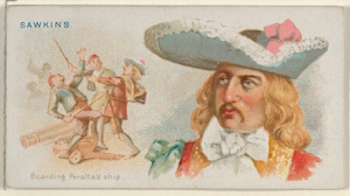
 Richard Sawkins, sometimes referred to as Sawkens or Hawkins, was a buccaneer known for his participation in the so-called Pacific Adventure under the command of John Coxon. It is uncertain exactly when he was born, although it is thought to have been in the early 1650s. As with many other buccaneers, little is known about his early life, but he probably went to sea at an early age. Sawkins was captured in 1677 while commanding the sloop Success and was imprisoned in Port Royal while waiting to be tried for piracy. The English government was becoming less tolerant of buccaneering activities at the time. He was either released or escaped from custody and is thought to have been in command of a 1-gun, 16-ton vessel with a crew of thirty-five men when he joined Captain Coxon’s expedition near Point Morant, Jamaica in March 1679. He became one of more than 300 buccaneers who later landed on the coast of Darien together with Bartholomew Sharp, Peter Harris, and Edmund Cook.
The Pacific Adventure
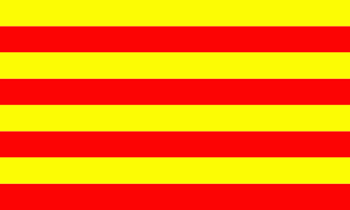 On 17th January 1680, the buccaneers successfully raided Porto Bello, later capturing two small Spanish vessels carrying provisions from Cartagena. They then sailed north to Bocas del Toro for careening and reprovisioning. After that, the buccaneers marched some 100 miles across the Darien isthmus through jungles and swamps to launch a surprise attack on the Spanish outpost of Santa Maria on 15th April 1680. They captured it with the aid of the Spanish-hating natives, the defenders taking twenty-six casualties while the buccaneers took none. Sawkins’ own contingent flew a yellow and red striped flag during the attack. The buccaneer force eventually reached the Pacific Ocean and entered the Gulf of San Miguel, where they captured two small Spanish vessels before heading towards Panama City, which had been rebuilt in a different location since Henry Morgan’s raid in 1671. They encountered a small Spanish fleet on nearing Panama City. On 23rd April 1680, Sawkins led an assault near Perico Island, where his 68-man force in canoes attacked three Spanish warships from the Panama fleet which were guarding the harbour Panama. After a fierce fight they overcame the Spanish force of 228 men commanded by Don Jacinto de Barahona, capturing two of the two vessels. Eighteen buccaneers were killed and twenty-two were injured; the Spanish losses were considerably higher. This encounter later became known as the Battle of Perico.
The blockade of Panama City
Bartholomew Sharp had already left the expedition to continue down the coast independently before the battle took place and, after a bitter dispute, John Coxon left with seventy men. He marched back to the Atlantic coast after being accused of cowardice, leaving Sawkins in charge of the remaining 116 buccaneers, who were by now low on resources. Sawkins was said to have been “a man who was as valiant and courageous as any could be.” After being elected leader, he sailed back to Panama City and blockaded the lightly defended harbour for two months, demanding 500 pieces of eight for each man and 1000 for each of the officers to leave. It is said he also spoke on behalf of the Darién natives, demanding the Spanish cease harassing them. The Spanish governor, Don Juan Pérez de Guzmán, did not respond to the demands, so the restless buccaneers eventually abandoned the blockade and sailed south.
Sawkins’ fate
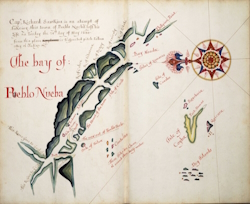 Under pressure to provide the buccaneers with sufficient plunder, Sawkins led an ill-advised assault on the settlement of Puebla Nueva on the on 22nd May 1680, during which he was hit by a musket ball, dying instantly. The Spanish had been forewarned of the attack and were prepared for it, having erected strong defences with which they repelled the attackers. The surviving sixty to seventy buccaneers promptly chose Bartholomew Sharp, who had rejoined Sawkins, as their new leader. Sharp ordered a hasty withdrawal, escaping on a Spanish bark and regrouping at Coiba Island. It is unknown what became of Sawkins’ body.