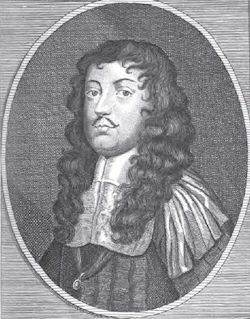
 Christopher Myngs (sometimes spelt Mings) was a naval officer and privateer, who was popular among the men for leading from the front. He cannot really be classed as a pirate in the strict sense of the word, but his close association with buccaneers has earned him a reputation as being more than just a naval commander. It isn’t certain exactly when he was born, but it is thought to have been some time in the early 1620s. He is known to have originated from Norfolk in East Anglia and that he was related to Admiral Sir Cloudesley Shovell. Samuel Pepys, the writer and politician, claimed Myngs’ father was a shoe maker and mother the daughter of a hoyman, a hoy being either a freight barge or a coastal fishing and trading vessel, usually sloop-rigged, used during the 17th and 18th centuries. He went to sea at an early age on merchant vessels, joining the Parliamentary navy during the English Civil War.
Myngs arrives in the Caribbean
Myngs first appears prominently in history as the captain of the 38-gun Elisabeth in 1653 during the First Anglo-Dutch War (1652-54) after the previous captain was killed in combat. He helped to capture a Dutch convoy taking two men-of-war as prizes. He continued to command the Elisabeth until 1655, when he was recommended for promotion. He then became the captain of 44-gun naval frigate Marston Moor. Commanding this ship, he took part in the conquest of Jamaica. When the crew mutinied due to unpaid wages, Myngs sympathised with them, but was also firm, punishing some of the ringleaders. Arriving in the Caribbean in November, he attacked Riohacha together with Admiral William Goodson. After that he spent some time on Jamaica doing various tasks as naval subcommander of the Jamaica Station, the name given to the command of the Royal Navy which existed there from 1655 to 1830.
Myngs the commerce raider
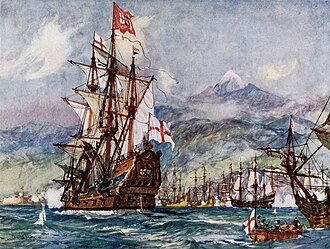 Myngs returned to England in 1657 and got married there. He went back to sea in December of the same year, capturing several Dutch vessels on his return to the West Indies in February 1658. He operated as a commerce raider, the name given to a naval vessel that attacked enemy merchant vessels, during the Anglo-Spanish War (1654–1660). During this period he acquired a reputation for unnecessary cruelty, sacking several Spanish colonial towns while in command of a large force of buccaneers. In October of 1658, Myngs attempted to capture a Spanish Treasure Fleet off the coast of Porto Bello but were unsuccessful. After helping to repel a Spanish attack on Jamaica, he led a large buccaneer fleet, which successfully sacked the Spanish settlements in Tolú and Santa Marta in New Grenada, in retaliation for the attack on Jamaica. He managed to seize a great deal of plunder there, including three ships. In 1659, he and his men plundered Cumaná, Puerto Cabello, and Coro, purportedly capturing twenty chests of silver.
Myngs and the buccaneers
Myngs came under criticism back home for sharing half of the plunder obtained from his 1659 raid, which amounted to about a quarter of a million pounds, with the buccaneers against the orders of Edward D’Oyley, the English Commander of Jamaica, despite the fact that without the aid of the buccaneers he probably wouldn’t have been successful in his endeavours. Because of this he was arrested for embezzlement and sent back to England in 1660, although his command was later restored by the reinstated monarch, Charles II, and in 1662 he escorted the new governor, Lord Windsor, to Jamaica while commanding the 46-gun Centurion. Lord Windsor promoted him to commodore. Despite peace with Spain he was to continue his buccaneering activities in an attempt to undermine Spanish influence in the area.
In 1662, buccaneers from all over the Caribbean joined him on the next expedition. Myngs commanded the largest buccaneer fleet yet to be assembled. It consisted of fourteen vessels with about 1,400 buccaneers on board the ships, among them Henry Morgan and Abraham Blauvelt. He led the force in an attack on Santiago de Cuba, taking the town despite its strong defences after landing 1000 men nearby and marching them by night to surprise the Spanish at dawn. They devastated the town and blew up the fort after discovering that the Spanish had already removed most of their wealth from. In February 1663, they went on to sack Campeche, suffering a staggering fifty casualties. Myngs was injured in the face and legs during the attack, leaving Edward Mansvelt in charge of the buccaneer fleet when he returned to England to recover in 1664.
Myngs’ fate
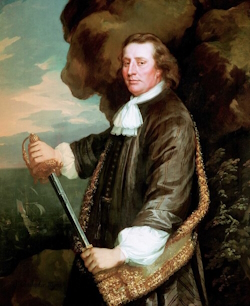 Although condemned by the English government for his attacks on Spanish colonies, he was made Vice-Admiral of Prince Rupert’s squadron in 1665. As Vice-Admiral of the White under the Lord High Admiral James Stuart, Duke of York and Albany, he participated in the Second Anglo-Dutch War at the Battle of Lowestoft in June 1665, for which he received a knighthood. In 1665, he served under Edward Montagu, 1st Earl of Sandwich, as Vice-Admiral of the Blue, later serving under the next supreme fleet commander, George Monck, 1st Duke of Albemarle. While in command of HMS Victory, he participated in the great Four Days’ Battle, which took place on 11th June 1666 during the course of the Second Anglo-Dutch War (1665-67). Unfortunately, his flotilla was surrounded by that of Vice-Admiral Johan de Liefde. He was wounded in the throat and left shoulder by musket balls during the engagement, dying of his wounds at his home in Whitechapel shortly after returning to London.