
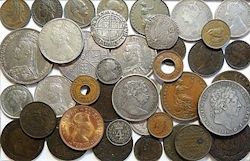
 There was a lack of coins in Britain’s American colonies, one reason being that in the 17th and 18th centuries, it was illegal to export British silver coinage to the colonies, although copper coins could be legally used. Additionally, colonists weren’t allowed to mint their own coins as this was solely a royal prerogative. In place of British silver coins, those from many different nations were used. This wasn’t a problem, because all coins were more or less worth there weight in silver or gold, so it wasn’t important which head of monarch or national emblem was imprinted on it. The foreign coins found in the colonies included German thalers and French écus. The most popular coin was the Spanish milled dollar, or piece of eight, which was legal tender in the US until the 1850s.
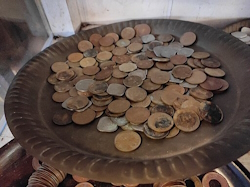 Coins were widespread in the 17th and 18th centuries in a time when no real paper money was in use. The denominations of the coins of the time might seem unusual to us today, but decimalisation of the coinage didn’t occur in the United Kingdom and Ireland until 15th February 1971. Before that date the currency of pounds, shillings, and pence had totally different values. The British pound sterling and the Irish pound were subdivided into 20 shillings, each with a value of 12 old pence, giving a total of 240 pence in a pound. With decimalisation, the pound kept its old value and name, but the shilling was abolished and the pound was divided into 100 new pence. Between 794 and 1200, the silver penny was the only denomination of coin in Western Europe until larger coins were introduced in the mid-13th century.