
Life Among the Pirates: The Romance and the Reality by David Cordingly
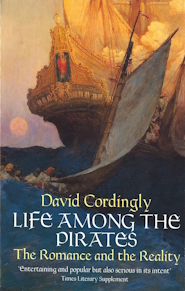 What were pirates really like? How much, if any, of the piratical stereotype – of a dashingly handsome man with an eye-patch, peg-leg and a parrot on his shoulder – is based on the documented fact. In this revealing and highly original study David Cordingly sets out to discover the truth behind the piracy myth, exploring its enduring and extraordinary appeal, and answering such questions as: why did men become pirates? Were there any women pirates? How much money did they make from plundering and looting? And were pirates really dashing highwaymen of the Seven Seas or just vicious cut-throats and robbers? From Long John Silver to Henry Morgan, Robert Louis Stevenson to J.M. Barrie, Life among the Pirates examines all the heavyweights of history and literature and presents the essential survey of this fascinating phenomenon.
Pages: 368
Published: 1996
ISBN: 978-0349113142
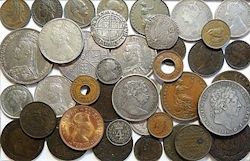 There was a lack of coins in Britain’s American colonies, one reason being that in the 17th and 18th centuries, it was illegal to export British silver coinage to the colonies, although copper coins could be legally used. Additionally, colonists weren’t allowed to mint their own coins as this was solely a royal prerogative. In place of British silver coins, those from many different nations were used. This wasn’t a problem, because all coins were more or less worth there weight in silver or gold, so it wasn’t important which head of monarch or national emblem was imprinted on it. The foreign coins found in the colonies included German thalers and French écus. The most popular coin was the Spanish milled dollar, or piece of eight, which was legal tender in the US until the 1850s.
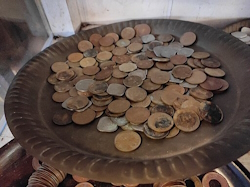 Coins were widespread in the 17th and 18th centuries in a time when no real paper money was in use. The denominations of the coins of the time might seem unusual to us today, but decimalisation of the coinage didn’t occur in the United Kingdom and Ireland until 15th February 1971. Before that date the currency of pounds, shillings, and pence had totally different values. The British pound sterling and the Irish pound were subdivided into 20 shillings, each with a value of 12 old pence, giving a total of 240 pence in a pound. With decimalisation, the pound kept its old value and name, but the shilling was abolished and the pound was divided into 100 new pence. Between 794 and 1200, the silver penny was the only denomination of coin in Western Europe until larger coins were introduced in the mid-13th century.
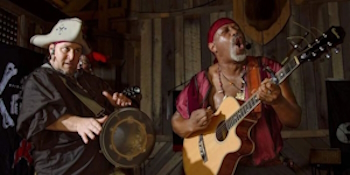 Pirates Creed is a dynamic duo composed of two best friends, known as the Navigator and the Quartermaster. They’re the masterminds behind the band’s unique sound, blending “grog rock” and “Sea Grass” music with a pirate twist. These two musicians have a long history of performing together, having met while playing in another pirate band at the Ohio Renaissance Festival. They decided to join forces and create Pirates Creed.
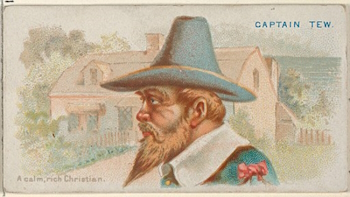 Thomas Tew was one of the most well-known Red Sea pirates active in the 1690s. It is thought he was born in 1649, but it is unsure exactly where. Suggestions include Rhode Island in the American colonies and Northamptonshire in England, although evidence seems to be lacking for the latter. Whether from Rhode Island or not, it is believed Tew had family in Rhode island. He was thought to have been married with two daughters, one of whom was named Amity, living in Newport, Rhode Island. He is best known, along with other infamous pirates such as