
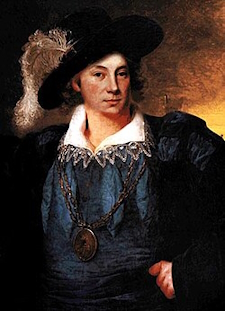
 De Graaf’s full name was Laurens Cornelis Boudewijn de Graaf. He was known as ‘El Griffe’ by the Spanish, Laurent de Graff by the French, and Gesel van de West by the Dutch, the latter meaning “Scourge of the West”. He was born in about 1653 and is described as being dashing in appearance; a tall, handsome fellow with blond hair and a moustache. He apparently deplored unnecessary violence and was known to reward loyalty generously, but also to enforce discipline ruthlessly at times. He probably grew up in Rotterdam, where he acquired the necessary nautical skills for his future career. It is thought he was captured by the Spanish, possibly after involvement in a raid on Campeche in 1672, and sent to work on a plantation as a slave to the Canary Islands. He either escaped or was freed sometime around 1675. He married Petronilla de Guzmán some time before 1674 before leaving the Canary Islands for the Caribbean. He first went to the Spanish settlement of Saint Augustine in La Florida. Not long after this, probably after arriving in the French colony of Saint Dominique, he began his buccaneering career, becoming the captain of a French privateer ship. He often sailed out on his own account to capture prizes. He is known to have had his own musicians, who accompanied him at sea.
De Graaf becomes a buccaneer
In the autumn of 1679 de Graaf attacked the Spanish Armada de Barlovento, capturing a 28-gun frigate, which he renamed the Tigre. He became increasingly so successful that Henry Morgan, while serving as lieutenant governor of Jamaica, sent the frigate Norwich, under command of Peter Haywood, with the primary aim of capturing de Graaf. Morgan unsuccessfully tried to hunt him down calling him “a great and mischievous pirate”. Angered by the loss of their frigate, the Spanish also sent ships out to hunt de Graf down. Rather than fleeing he sailed to meet them, forcing the Princesa, which was bound for Santo Domingo carrying 120,000 pesos, to surrender after several hours of battle. After returning to his base at Petit-Goâve he made Princesa his flagship, renaming it Fransesca.
The attack on Veracruz and Cartagena
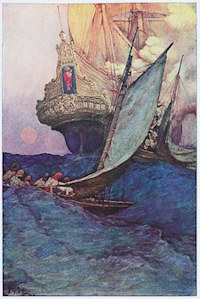 Next, de Graaf sailed to Cartagena together with the Dutch buccaneer Michiel Andrieszoon, but with little success, so they moved on to the Gulf of Honduras, where they discovered two Spanish galleons not yet loaded with cargo. De Graaf decided to careen on Bonaco Island while waiting for them to be loaded, but their plan was spoiled when the Dutch pirate Nicholas van Hoorn captured the ships while they were still empty. Despite this, de Graf let van Hoorn join his fleet together with the French privateer Michel de Grammont for an attack on Veracruz. The expedition of thirteen vessels and 1300 pirates easily captured the town via land and sea in May 1683, the buccaneers allegedly committing numerous atrocities while they were there. Additionally, 1300 men, women, and children of African descent were abducted and sold into slavery on Saint Domingue and Jamaica.
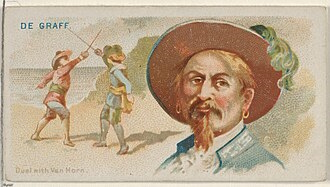
A dispute broke out between van Hoorn and de Graaf over the treatment of the hostages and the division of spoils, and it is thought they both fought a duel, in which van Hoorn was wounded, dying from an infection two weeks later. The pirates swiftly left when Spanish warships were spotted. In November 1683, de Graaf made it to Cartagena with seven ships, where they met resistance from the Spanish governor Juan de Pando Estrada, although the Spaniards were unable to overcome the more experienced buccaneers. The Spanish 40-gun ship San Francisco ran aground and two other vessels were captured. De Graaf took the San Francisco as his new flagship, renaming it the Fortune, and later the Neptune. After releasing the prisoners, the pirates blockaded the town. After encountering an English fleet without incident and turning down a pardon from the Spanish, de Graaf returned to Petit-Goâve.
The attack on Campeche
 De Graaf prowled for merchant vessels in the area during the autumn of 1684, but with little success. Eventually, he sailed to the Isla de Pinos, where he gathered a force of buccaneers to raid Campeche, which they did in July 1685. After considerable resistance, the Spanish abandoned the town taking their valuables with them. The buccaneers spent two months in the town, but failed to secure a ransom, so they set it ablaze and killed some of the prisoners, despite de Graaf’s attempts to minimize the violence. The pirates left with the remaining captives, in the hope of receiving a ransom for them later. Not long after, de Graaf left the main fleet and was attacked by two Spanish ships. He only managed to escape by dumping his cargo and cannons overboard. In February 1686, the Spanish attacked de Graaf’s property on Saint Dominque. In retaliation, de Graaf sacked Tihosuco on the Yucatán peninsula together with Michel de Grandmont. While returning to Petit-Goâve, he accidently wrecked his ship while pursuing a Spanish barque, but still managed to capture it using only his ship’s long boat.
De Graaf’s later career
In 1687, after taking several smaller vessels, de Graaf helped defend Petit-Goâve against a Spanish attack. At the end of 1689, he took part in a six-month blockade of Jamaica for the French after the outbreak of the Nine Years’ War in Europe. In January 1691, he participated in anattack on Santo Domingo but suffered defeat at the hands of a Spanish force three times the size of his own French one. He only narrowly escaped with his life. He met and married his second wife, Anne Dieu-le-Vent in March 1693, allegedly after she threatened to shoot him for insulting her. After that he took part in more raids on Jamaica together with fellow captain Francois Le Sage. De Graaf’s family were taken prisoner in an English retaliatory attack on Port-de-Paix.
Laurens de Graaf’s fate
Laurens de Graaf’s fate is still uncertain. In his later years, his activities declined when colonial authorities increased their efforts to stamp out piracy. Despite this, de Graaf remained active into the early 1700s, taking part in small-scale raids and in the Caribbean. With his reputation intact, but his health and likely deteriorating with age it has been suggested that he attempted to settle down or retire from piracy. He was last sighted near Louisiana, where he was helping to set up a French colony near present-day Biloxi, Mississippi. Some sources claim he died there, or somewhere in Alabama. There are other claims that he in fact died on Santo Domingo or on the island of Tortuga in 1704.