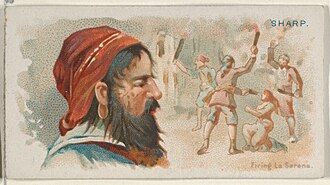
 Bartholomew Sharp took on the role of buccaneer, privateer, and pirate at different times in his sea-faring career. Little is known about his early life, except that he was born in 1650 in the parish of Stepney in London. He first went to sea at a young age serving as a privateer during the second Anglo-Dutch war of 1665-67. He is thought to have served under Henry Morgan in the Caribbean, possibly during the infamous Panama raid in 1671. When peace was signed between England and Spain in the Treaty of Madrid in 1670, he became a privateer against the Dutch during the Third Anglo-Dutch war of 1672-74, obtaining the command of his own vessel in the Caribbean while fighting against the Dutch in the Leeward Islands. Once peace had been signed with the Dutch he and his men illegally turned their attention to the Spanish colonies, attacking Segovia in 1675 and capturing of Santa Marta in 1677, as well as later seizing a Spanish merchant ship in the Bay of Honduras.
Sharp the buccaneer
Sharp and his accomplices raided the Spanish indigo trade while in Honduras. He had obtained a commission to cut logwood there, which then used as a cover to attack the Spanish. In December 1679, he arrived in Port Morant, Jamaica to work together with the buccaneer captains John Coxon, Robert Allison, Cornelius Essex, and Thomas Magott, agreeing to attack Portobelo on the Spanish Main the following year with the help of the native tribe, the Kuna. John Coxon was elected commander of the expedition. They were later joined by the French pirates Rose and Bournano. They raided Portobelo on 17th January 1680 before moving on to Bastimentos, which lay not far to the north-east. There they distributed the booty, blockading the port for two weeks and seizing several unsuspecting merchant ships.
 Their next target was the newly rebuilt city of Panama, which had been constructed on a different site after Henry Morgan’s attack of the original city in 1671. John Coxon was still in command at the time. The buccaneers left their ships off the coast of Darién and 350 pirates went over land as Morgan had previously done. The expedition included William Dampier, Welsh surgeon and naturalist Lionel Wafer, and ship’s doctor Basil Ringrose, all of whom made a record of their travels and exploits. On their way to the Pacific coast the raiders attacked the town of Santa Maria together with their Kuna allies, quickly overwhelming its garrison. On reaching the Pacific coast, they captured a small Spanish vessel, which they used to explore the islands before fighting a successful naval engagement in canoes against several Spanish vessels, capturing a barque while only losing two men, although Captain Peter Harris died of his wounds a few days later. The buccaneers captured several abandonded warships near Panama, taking La Santísima Trinidad as their flagship and renaming it Trinity. Coxon was later deposed, subsequently leaving for the Caribbean with 75 men, being replaced by Richard Sawkins. The buccaneers further enraged the Spanish governor by capturing a galleon carrying 60,000 pieces of eight intended for the pay of the soldiers based in Panama. Not long after, Sawkins was killed in an attack on the Spanish town of Puebla Nueva, prompting a further 75 men to leave the expedition.
Sharp the commander
Sharp was made commander after Sawkin’s death. He was not too popular as a leader, being too cautious for many. He failed to capture any prizes of real value while sailing down the Pacific coast, mainly because there weren’t many potential victims and the towns had been warned about the pirates’ presence, giving them time to prepare their defences. Eventually, Sharp and his men captured a Spanish galleon sent out to hunt down the pirates. Sharp is said to have tortured the prisoners and killed a Spanish friar in front of all the men, causing many among the crew to begin to question his suitability for command. He became increasingly unpopular with the crew after winning a great deal of money from them in gambling. He is also thought to have fired a pistol at one of the crewmembers. In January 1681, a mutiny was led against him by former friend John Cox, and violence was only averted when the crew voted to replace him with John Watling, who promptly clapped Sharp in irons. Watling was killed when they later attacked the town of Arica. Sharp was then reluctantly reinstated as captain after he had saved the other pirates from annihilation at Arica. Shortly thereafter fifty more men left the voyage, including William Dampier and Lionel Wafer.
Sharp leaves the Pacific
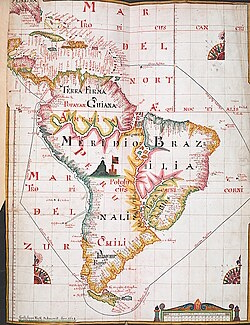
The pirates returned to the Caribbean in 1681 by sailing around the southern tip of South America, capturing ships and settlements along the way, in particular obtaining some useful nautical charts. The most notable prize was the Santo Rosario, on board of which there were several hundred ingots of silver, which the pirates mistook for tin and therefore left behind. Captain Sharp is credited as being the first Englishman ever to travel eastwards around Cape Horn, although he had planned to pass through the Strait of Magellan, but was prevented from doing so by a storm which pushed his vessel too far south, forcing him to navigate the Cape instead. Although impressed by his exploits, Henry Morgan called for the arrest of Sharp and his men, many of whom had previously served under him, while lieutenant governor of Jamaica.
Sharp’s end
The Spanish viewed Sharp as a pirate and since the practice of buccaneering was no longer viewed as a legal enterprise by the English government after the signing of various peace treaties, they also became treated as such by their own government. Because Spain and England were no longer at war, the Spanish demanded Sharp’s extradition to face charges of piracy. Sharp was therefore arrested and brought before the High Court of Admiralty, but on presenting the authorities with the charts and maps taken from the Spanish ship El Santo Rosario, he received a full pardon from Charles II. In 1696, Sharp moved to the island of St. Thomas in the Danish West Indies, but by 1700 he had fallen deeply into debt. He tried to flee the island and the Danish colonial authorities, but was captured and put in prison, where he died on 29th October 1702.
Bartholomew Sharp’s legacy
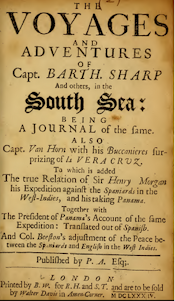 After being translated by Philip Dassigny, a sailor on Sharp’s ship, the captured sea charts became invaluable to English seafarers, who knew little of the Pacific coast of the Americas at that time. They were later redrawn by William Hack in about 1684, known as South Sea Waggoners or Wagoner of the Great South Sea. Sharp himself left a journal describing his exploits and what he saw, although they didn’t contain as much detail as those of Dampier and Ringrose. An eyewitness account of Sharp’s adventures was published in The Dangerous Voyage And Bold Assaults of Captain Bartholomew Sharp and Others by Basil Ringrose in 1684 and William Dampier gave a brief account of his time together with Sharp and the buccaneers in his 1697 book A New Voyage Round the World.