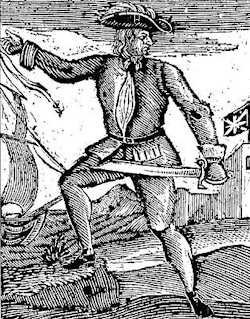
 Howell Davis was born in 1690 in Milford Haven, Pembrokeshire in Wales. His name was sometimes spelled Hywel Davies. It is said that he grew up around the sea and was a more than competent sailor. Never his plan to become a pirate, his short pirating career lasted from July 1718 to June 1719, during which time he captured fifteen ships. According to the account written by Captain William Snelgrave some years later in 1734, Davis was not a cruel man. He wrote that Davis intervened to save him from being abused by the men of pirate captain Thomas Cocklyn, who had captured Snelgrave and his ship.
Davis the Pirate
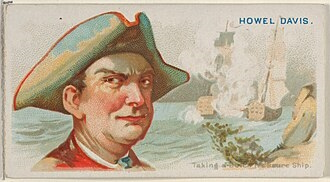
Davis was serving aboard Cadogan, a British slave ship, as a mate when it was captured by Edward England in 1718. Although at first seemingly reluctant to join the pirates, refusing point blank to sign the articles, he eventually chose to join them and was given command of the Cadogan. He immediately sailed to Brazil, possibly to sell the vessel there. The crew decided against it and they all sailed to Barbados to sell the captured cargo. It’s unsure whether Davis agreed with this decision. While there, Davis was imprisoned for piracy, although there seemed to be little evidence of his crime, so he was released after a few months. After his release he sailed to the pirate haven of Nassau on New Providence, which unbeknownst to him had fallen under the control of Woodes Rogers at that time. He left there on a sloop called the Buck, later taking over the vessel off the coast of Martinique together with Thomas Anstis and Walter Kennedy. Davis was then elected captain. He is thought to have captured two French ships off Hispaniola and carried out raids from his base on the island of Ruatan off the coast of Honduras.
Across the Atlantic
Davis and his crew decided to cross the Atlantic and plunder ships around the Cape Verde Islands, where they worked together with Thomas Cocklyn and the French pirate Oliver Levasseur. There Davis captured the 26-gun Saint James, making it his flagship. Davis and Cocklyn seized a ship together called Bird, which was captained by William Snelgrave. Davis intervened on seeing the abuse of Snelgrave at the hands of Cocklyn’s men. This made a favourable impression on the captive captain, who documented the incident later for the authorities. At some point later, the pirates fell out after a drunken dispute, after which Davis sailed to the African Gold Coast, the region on the Gulf of Guinea in West Africa, in the 32-gun Rover, capturing more prizes along the way. One captive was the future pirate captain Bartholomew Roberts, who became Davis’s favourite. Posing as a legitimate merchant or privateer, he managed to capture both the slaving fort and the commander of a Royal African Company in Gambia after being invited to dinner, subsequently ransoming him for 2000 pounds of gold. Additionally, the pirates captured a superior gunned French ship by making its captain believed they were better armed than they in fact were.
Davis’s flag
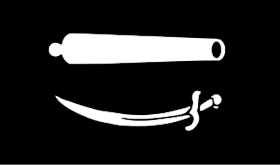 It is unsure exactly what form Davis’s flag took, but a description of can be read in an account from The Information of Edward Green published on 29th April 1721, which can be found in the book Pirates in Their Own Words: “… hoysted up a black flag with a Death’s head and fired several Guns at the said Ship and took her within Sight of the said Island.” Another description can be found in Jolly Rogers – the True History of Pirate Flags by the same author: “… their Standard, which they hoisted at Main-topmast-head, with a Gun and Sword.”
Davis’s fate
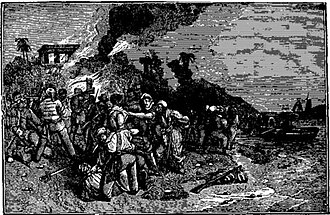 Davis met his end when he pretended to be a naval pirate hunter in order to gain access to and kidnap the governor of the Portuguese island of Príncipe. Unfortunately for him, the governor saw through his plan, instead inviting him to the fort on 19th June 1719 for a glass of wine and ambushing him on the way there. Davis was shot dead during the attack. Bartholomew Roberts was then elected to succeed him as captain, later attacking and plundering the island in retaliation.