
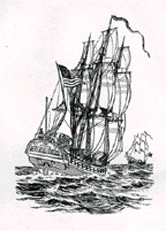
 Under this act British subjects serving as privateers for an enemy of Great Britain could be tried for a felony not treason. It was easier to convict someone of a felony than prove treason. It was passed during the War of Austrian Succession waged from 1740 to 1748, in which Britain fought against France and Spain. As with many wars before, privateers were an integral part of the armed forces of all powers, and it would seem that British citizens regulary found employment with foreign powers.
An example of using privateers to support navies, occurred in 1744, when a British force of 300 men accompanied by two privateers from Saint Kitts successfully captured the French half of neighbouring Saint Martin. In late May 1745, two French royal frigates of 36 and 30 guns respectively under Commodore La Touché, together with three privateers sailed from Martinique to invade and capture the British colony of Anguilla in retaliation, but were repelled with heavy loss in the Battle of Anguilla.
During War of Austrian Succession, Louisbourg in Nova Scotia became a haven for French privateers. These men were instrumental in the supply and defence of Port Royal (Nova Scotia) and Louisbourg from English privateers who hailed from New England. A successful privateers was the Cantabre, an eighty-ton schooner with eight guns and a crew of ninety-four. Commanded by Captain Doloboratz, she captured a provincial warship of Massachusetts.
1744 CHAPTER 30 18 Geo 2
An Act to amend the Piracy Act 1698
1
Whereas by the Piracy Act 1698; it is (amongst other things) enacted, that all piracies, felonies, and robberies committed on the sea, or in any haven, river, creek, or place where the admiral or admirals have power, authority, or jurisdiction, may be examined, enquired of, tried, and determined and adjudged, according to the directions of the Piracy Act 1698, in any place at sea, or upon the land, in any of his Majesty’s islands, plantations, colonies, dominions, forts, or factories, to be appointed for that purpose by the King’s commission, in the manner therein directed:
And it is also thereby further enacted, that if any of his Majesty’s natural born subjects, or denizens of this Kingdom shall commit any piracy or robbery, or any act of hostility, against others of his Majesty’s subjects, upon the sea, under colour of any commission from any foreign prince or state, or pretence of authority from any person whatsoever, such offenders shall be deemed pirates, felons, and robbers;
And they being duly convicted, according to the Piracy Act 1698, or according to the Offences at Sea Act 1536, therein recited, shall have and suffer such pains of death, loss of lands, goods and chattels, as pirates, felons, and robbers upon the seas, ought to have and suffer:
And whereas, since the present wars with France and Spain, divers of his Majesty’s natural born subjects have entered in the service of his Majesty’s enemies, on board privateers, or other ships, having commissions from the crowns of France or Spain, and committed divers hostilities against his Majesty’s subjects upon the seas, in the West Indies, and other parts:
And whereas doubts have arisen, whether as such offenders have, by such their adherence to the King’s enemies, been guilty of high treason, they can be deemed guilty of felony, within the intent of the Piracy Act 1698, and, as such, liable to be tried by the said court of admiralty appointed or to be appointed by virtue of the Piracy Act 1698:
Therefore, to put an end to the said doubts, and to prevent the inconveniencies that must arise, by the want of speedy justice on such offenders; may it please your most excellent Majesty, that it may be enacted; and be it enacted by the King’s most excellent Majesty, by and with the advice and consent of the lords spiritual and temporal, and commons, in this present parliament assembled, and by the authority of the same, that all persons being natural born subject, or denizens of his Majesty, who during the present or any future wars, have committed, or shall commit, any hostilities upon the sea, or in any haven, river, creek, or place, where the admiral or admirals have power, authority or jurisdiction against his Majesty’s subject, by virtue or under colour of any commission from any of his Majesty’s enemies, or have been, or shall be any other ways adherent, or giving aid or comfort to his Majesty’s enemies upon the sea, or in any haven, river, creek, or place, where the admiral or admirals have power, authority or jurisdiction, may be tried as pirates, felons and robbers in the said court of admiralty, on ship-board, or upon the land, in the same manner as persons guilty of piracy, felony and robbery, are by the Piracy Act 1698 directed to be tried;
And such persons being upon such trial convicted thereof, shall suffer such pains of death, loss of lands, goods and chattels, as any other pirates, felons and robbers ought, by virtue of the Piracy Act 1698, or any other Act, to suffer.
2
Provided, and it is hereby declared and enacted, that any person who shall be tried and acquitted, or convicted, according to this Act, for any of the said crimes, shall not be liable to be indicted, prosecuted, or tried again in Great Britain, or elsewhere, for the same crime or fact as high treason.
3
Provided, that nothing in this Act contained shall be construed to extend to prevent any persons guilty of any of the said crimes, who shall not be tried according to this Act, from being tried for high treason within this realm, according to the Offences at Sea Act 1536.