“He had a great deal of good Nature, and did not want for Courage; he was not avaritious, and always averse to the ill Usage of Prisoners received.”
— Charles Johnson on Edward England in A General History of the Pyrates, 1724.
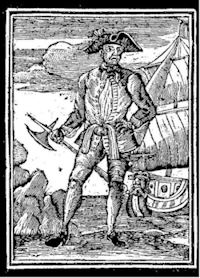 Although not the most well-known pirate captain, Edward England was considered important enough to receive his own chapter in Charles Johnson’s A General History of the Pyrates. It is thought by some that his real name might have been Jasper Seegar, although others dispute this, claiming this name belonged to different pirate. England was born around 1685 in Ireland and was possibly a Catholic and a Jacobite. He started his career as a sailor and probably fought in the Spanish War of Succession as a privateer. After the war he found employment as a mate aboard a merchant sloop sailing out of Jamaica until it was captured by a pirate ship commanded by Christopher Winter. He was forced to join the crew, accompanying them to Nassau, where he is thought to have joined ‘the Flying Gang’. He seems to have eventually embraced or resigned himself to the pirate way of life. He is said to have flown the classic Jolly Roger similar to Sam Bellamy and other members of the Flying Gang. As well as being well-educated, he has been described as being courageous and good-natured, generally more compassionate and less greedy than most other pirates of the time.
In the Caribbean
In 1716, Edward England took part in salvaging wrecks of sunken Spanish treasure fleet along with Henry Jennings and other future pirates, but it is unsure as to whether he commanded his own vessel at that time. He is thought to have served for a while as Charles Vane’s quartermaster and was one of those taken prisoner by Vincent Pearse, commander of HMS Phoenix, when Vane’s sloop Lark was captured, although he was released with the others in an attempt to win over the pirates of Nassau. Considering he didn’t become a pirate of his own free will, he was surprisingly one of those who rejected the King’s pardon. Instead, he sailed to Africa, leaving those who had taken the pardon far behind after deeming it too dangerous to remain there. He was known to have flown the now-classic version of the Jolly Roger pirate flag with a white human skull above crossbones on a black background.
Off the coast of Africa
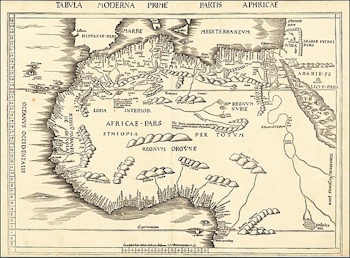 In 1719, Edward England took several ships in the Azores, Cape Verde Islands, and off the coast of West Africa, including a snow called Cadogan from Bristol, commanded by Captain Skinner. According to Johnson in A General History of the Pyrates, some of England’s crew recognized Skinner who had allegedly not paid them for work they had done in the past, and had had them transferred to a naval vessel to be rid of them. Those seamen had managed to escape from that servitude eventually become pirates. After tying him to a windlass and throwing bottles at him, they shot him in the head. Howell Davis joined England’s crew at this point. It is claimed that Davis refused to sign the articles, saying he’d rather die than become a pirate. Despite this, England spared him and gave him command of the Cadogan, in which he sailed to South America, later becoming a pirate after all. England captured at least 10 prizes off the West African coast, including the Pearl, which he kept for himself, renaming it Royal James. He also captured the 12-gun Bentworth of Bristol. He kept two ships as prizes, granting them to Captains Robert Lane and Richard Sample, who then chose to sail to the Caribbean. Another vessel he seized while cruising along that coast was the Peterborough of Bristol. England made John Taylor the captain of Peterborough which he renamed Victory. Two ships England encountered took shelter under Cape Corso Castle, where he unsuccessfully attempted to set them on fire. After plundering a further two ships, England and his crew decided to stop for a while in a small African town, but the pirates grew increasingly belligerent and disputes arose with the locals over the treatment of their women. At some point a fight broke out, resulting in the pirates burning the entire town before departing.
In the Indian Ocean
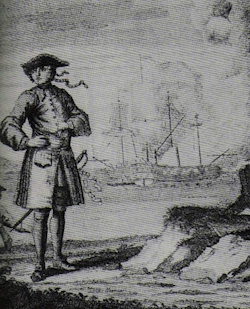 The pirates then voted to head towards the Indian Ocean, arriving in Madagascar at the beginning of 1720. After resupplying, they then sailed to the Malabar coast, where they targeted mainly Dutch and Mughal Indian vessels. It is thought England joined with the French pirate Oliver Levasseur and they operated together in the Indian Ocean for a while. While there England captured a thirty-four gun Dutch ship, which he named Fancy in honour of English pirate Henry Every, making it his new flagship. England and his crew took their greatest prize in the Mascarene Islands near Madagascar, a Portuguese ship with 60-70 cannons. It would have been deemed too powerful for the pirates to consider as a target had it not been undergoing repairs after being badly damaged in a recent storm. The ship was not only carrying high-value goods, including a large amount of diamonds, but also the viceroy of Portuguese Goa.
On 17th August 1720, they encountered the British East Indian Company ship Cassandra, commanded by James Macrae, in the Bay of Johanna Island (now Anjouan), which lies near the island of Comoros. The ship had come to destroy the nest of pirates there. The ship accompanying Cassandra, called the Greenwich, commanded by Robert Kirby, fled along with a Dutch vessel leaving Macrae to single-handedly engaged England’s two vessels. During the combat, which lasted for over three hours, Macrae and his men killed almost a hundred of the pirates, who had numbered about 500. However, after a total of seven hours of battle both ships had run aground, forcing Macrae and his men to abandon his badly damaged ship and hide on the island for ten days, eventually surrendering to the pirates. This battle was later described by historian Eric J. Grahams as the “bloodiest engagement and killing of pirates along the African coast”. After the battle, the surviving pirates plundered the Cassandra for £75,000. England was a merciful man and wanted to spare Macrae, along with 43 of his men, so he presented him with the heavily damaged Fancy.
Edward England’s fate
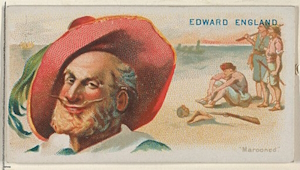 The act of compassion towards Macrae led to the pirate captain’s eventual downfall when rumours circulated that the freed Macrae was planning to return and hunt down the pirates. This pushed the the crew into deposing England, who they believed had been too lenient, and they marooned him with three others on the coast of Isle de France, modern day Mauritius. Jasper Seagar was elected as the new captain of the Fancy. Fortunately for the stranded pirates, there was plenty to hunt on the island that, although claimed by France in 1715, was in fact otherwise deserted. After four months, England and the loyal crewmen who had been stranded with him managed to build a boat using wood from the wrecks of vessels abandoned by the Dutch and subsequently sail to the pirate haven of St. Augustine’s Bay in Madagascar. He arrived there in poor health and without any money, being forced to rely on the charity of the pirates who had settled there. It is thought he died sometime in the winter of 1720–21, possibly from a tropical disease. A little too kind hearted, Edward England was probably not really cut out for life as a pirate in the late Golden Age.