
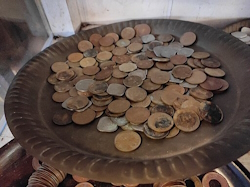
 Coins were widespread in the 17th and 18th centuries in a time when no real paper money was in use. The denominations of the coins of the time might seem unusual to us today, but decimalisation of the coinage didn’t occur in the United Kingdom and Ireland until 15th February 1971. Before that date the currency of pounds, shillings, and pence had totally different values. The British pound sterling and the Irish pound were subdivided into 20 shillings, each with a value of 12 old pence, giving a total of 240 pence in a pound. With decimalisation, the pound kept its old value and name, but the shilling was abolished and the pound was divided into 100 new pence. Between 794 and 1200, the silver penny was the only denomination of coin in Western Europe until larger coins were introduced in the mid-13th century.
Originally, coins were made of precious metals and possessed an intrinsic value. This is known as commodity money, as opposed to fiat money, which only has value because a government declares it to be so. As a rule, gold is worth about 20 times more than silver, therefore a gold penny would be worth 20 silver pennies. Silver is 20 times the value of copper. Some countries used electrum, which is a naturally occurring alloy of gold and silver with one electrum coin being worth ten silver ones. Billon, an alloy of silver or gold mixed with a varying higher percentage of copper, was also used in some coins outside of Britain, such as in Barcelona and the German states. Copper coins were often a token currency, meaning they didn’t always contain the intrinsic value of the metal, usually only being worth about half their weight in copper.
The coins then were worth more and had a higher purchasing power than those of today, but one problem was that there was often a lack of small coins that enabled a trader to give change. This resulted in coins being cut up. This wasn’t such a problem with larger coins and worked as long has the coin was worth its weight in gold or silver, but it later became normal that coins varied from their value of their precious metal content and therefore could no longer be classed as bullion, which means they were no longer pure gold or silver.
To prevent gold and silver coins being clipped, thus lowering their value, milling was introduced in England during the reign of Elizabeth I and on mainland Europe even earlier. Milling was the process of making a raised edge on a coin and making narrow, radial grooves on the raised edge, so it was clear if the coin had been clipped. It became normal practice under Charles II. We see milling on modern coins although there is no longer any reason to clip them. The steam-powered mint, introduced in 1797, made it easier to mint and mill quality coins.
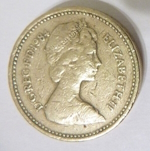 Pound – The British Pound Sterling’s origins date back to the Anglo-Saxon period, specifically to the early 8th century. Initially, the term ‘pound’ referred to a unit of weight that was equivalent to a pound of silver. The term is derived from the silver coins known as ‘sterlings’, which were issued in the Saxon kingdoms in about 775AD. 240 of them were minted from a pound of silver. By the late medieval era, the Pound Sterling had transitioned from a simple unit of weight to a recognized currency, central to daily commerce and trade. The modern pound sign ‘£’ comes from the L, which stands for the Latin word libra, meaning pound. The strokes that cross the pound sign are common to most currencies.
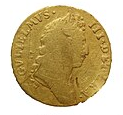 Guinea – This was a gold coin introduced by Charles II, which was minted in Great Britain between 1663 and 1814. The name came from the Guinea region in West Africa, from where much of the gold used to make the coins came from. It was the most valuable coin in England, containing approximately one-quarter of an ounce of gold. Initially, it was worth one pound, but from 1717 to 1816 its value changed to 21 shilling due to the amount of gold used in it together with an increase in gold prices. During the Great Recoinage of 1816, the guinea was demonetised and replaced by the gold sovereign. Two guinea and five guinea coins also existed and there were four crowns plus one shilling in a guinea.
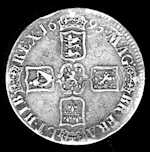 Crown – Initially known as English crowns, these coins were first minted in the Kingdom of England before it was united with Scotland. From 1707 it became known as the British and was minted until 1971. It was a silver coin worth a quarter of one pound, five shillings, or 60 pence. A half crown coin also existed.
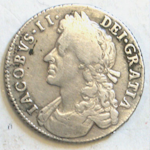 Shilling – The British shilling was a silver coin until 1816, the silver gradually reduced after that. A shilling was abbreviated as ‘1s’ or ‘1/-‘ and was often referred to as a ‘bob’. It was a popular unit of currency and a denomination of sterling coinage worth 1⁄20 of one pound, or twelve pre-decimal pence, meaning there were 20 shillings were one pound. The word shilling is believed to have derived from the Old English word ‘scilling,’ which means to divide or to separate into parts.
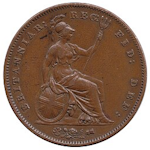 Penny – Coins known as pennies were issued primarily in silver, playing a crucial role in facilitating transactions across the fragmented territories. It became the standard coin under the Anglo-Saxons. Charlemagne set the value of 240 pence for one pound, a useful number divisible by both 2 and 3. The silver penny became widely accepted after 1066, and its uniformity facilitated trade on a national scale. Pennies were abbreviated as ‘1d’ or ‘-/d’. When they were made of silver, they could have a varying pence value depending on the weight – normally 4, 3, 2 (tuppence) and 1. A four pence coin was known as a groat. Pennies were made of silver until 1816 with bigger copper ones first being used at end of 18th century.
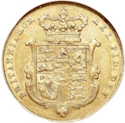 Sovereign – This coin was made of gold and was worth one pound or 20 shillings. It was minted from 1817 onwards and was originally a circulating coin that was accepted not only in Britain also elsewhere in the world. Although no longer in circulation, it is still legal tender in the UK. The coin was named after the English gold sovereign, which was last minted in about 1603.
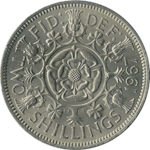 Florin – The British florin was issued from 1849 to 1967 and was worth 2 shillings, there being 10 florins in a pound, which made it an early form of decimalisation. A double florin also existed. Initially it was made mainly of silver, but after 1947 it was made of cupronickel, its silver content already having been reduced in 1920. It was also known as a two shilling or two bob coin, abbreviated as 2/-. The English coin first issued in 1344 by Edward III of England is also known as a florin.
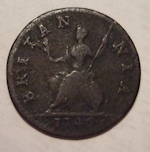 Farthing – The British farthing was a bronze coin equal to a quarter of a British penny or 1/960th of a pound sterling. Minted between 1860 and 1956, it was finally withdrawn from use in 1961. Replacing the earlier English farthing, it was initially minted in copper, and then later in bronze. The early English farthings were silver until copper ones were introduced by James I, and they were minted until 1707, when the Act of Union united England and Scotland. It was half the size of a ha’penny, or half a penny. There were 24 half pennies in a shilling and 480 in a pound.
Summary of values:
1 pound = 4 crowns = 10 florins = 20 shillings = 240 pence = 960 farthings
1 guinea or sovereign = 21 shillings