
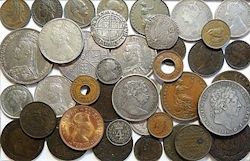
 There was a lack of coins in Britain’s American colonies, one reason being that in the 17th and 18th centuries, it was illegal to export British silver coinage to the colonies, although copper coins could be legally used. Additionally, colonists weren’t allowed to mint their own coins as this was solely a royal prerogative. In place of British silver coins, those from many different nations were used. This wasn’t a problem, because all coins were more or less worth there weight in silver or gold, so it wasn’t important which head of monarch or national emblem was imprinted on it. The foreign coins found in the colonies included German thalers and French écus. The most popular coin was the Spanish milled dollar, or piece of eight, which was legal tender in the US until the 1850s.
In 1652, under the rule of Oliver Cromwell, Massachusetts minted its own shillings which consisted of three quarters as much silver as contained in the British shilling. Their lower value ensured that they remained in the colonies. These shillings later became popular in the Caribbean colonies. The English government put a end to them in 1682. With the US Coinage Act of 1792 decimal coinage was introduced in the USA, which established the US dollar as being worth 100 cents. Russia was the only other country that had adopted a decimal system prior to this.