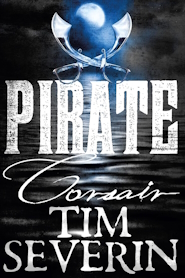
 Corsair by Tim Severin is the first swashbuckling adventure in the Pirate series. 1677. On a late-summer’s evening, two ships lurk off the coast of southwest Ireland. Seventeen-year-old Hector Lynch wakes to the sound of a pistol shot as the Barbary corsairs raid his village, and he and his sister are snatched. Separated from each other, Hector is sold at auction in Algiers, and thrown into a bewildering world where life is cheap and only the quick-witted survive. In North Africa, Hector befriends fellow captive Dan, a Miskito Indian from the Caribbean, and the two men convert to Islam to escape the horrors of the slave barracks – only to become victims of the deadly warfare of the Mediterranean. Serving aboard a Turkish ship, their vessel is sunk at sea and by a savage twist of fortune they are chained to the oar bench of a French galley. Desperate to find his sister, Hector finally stumbles on the chilling truth of her fate when he and Dan are shipwrecked on the coast of Morocco.…
Author: savage
Books by Rafael Sabatini
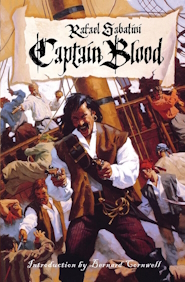 Wrongfully convicted of treason, a man escapes from slavery in the West Indies and becomes a pirate, determined to right the injustices that he sees around him, but his quest is undermined by his love for the plantation owner’s beautiful niece, in a swashbuckling, historical adventure.
Pages: 378
Published: 1922 (reprint 2002)
ISBN: 978-0393323290
Jolly Rogers
Jolly Rogers – the True History of Pirate Flags by E.T. Fox
 The ‘jolly roger’ is probably the most iconic flag in the world. Nobody can see the skull and cross-bones without thinking ‘pirates’. This carefully-researched book explores the history of the famous pirate flag, its many variants, and includes descriptions and illustrations of every ‘jolly roger’ recorded during the ‘golden age’ of piracy in the eighteenth century.
Pages: 82
Published: 2015
ISBN: 978-1326448172
Ned Lowe

One of the most blood-thirsty pirates active in the Caribbean, in the Azores, and along the coast of North America. He was active between 1721 and 1724, his fate being disputed by historians. The above flag was used by the notorious Edward Lowe from July 1723 during the time he called himself admiral and is taken from a description by Charles Johnson in A General History of the Pyrates – “… and hoists a black Flag, with the Figure of Death in red, at the Main-topmast Head …”
The 1692 Port Royal Earthquake
“…the great Calamity that hath befallen this Island by a terrible Earthquake, on the 7th instant, which hath thrown down almost all the Houses, Churches, Sugar-Works, Mills and Bridges, through the whole Country. It tore the Rocks and Mountains, destroyed some whole Plantations, and threw them into the Sea, Port-Royal had much the greatest share in this terrible Judgement of God.” – Dr. Emmanuel Heath, Anglican rector of St. Paul’s Church, Port Royal
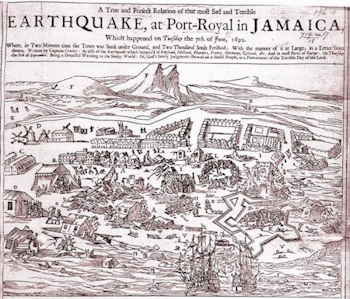 In 1692, Port Royal was the main British base in Caribbean, which had been captured from the Spanish in 1655. The town became a thriving centre of trade and privateering, but by 1692 the focus had shifted to the cultivation of tobacco and sugar cane with an increased growth in the slave trade. Port Royal was built on a peninsula off the coast of Jamaica across from present-day Kingston and was religiously and culturally very diverse. At its height in 1692, the population of the town is estimated to have exceeded 6500 inhabitants, of which about 2500 were slaves.…