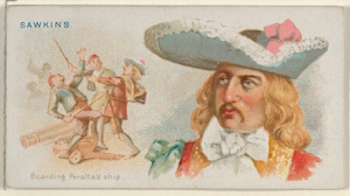
 Richard Sawkins, sometimes referred to as Sawkens or Hawkins, was a buccaneer known for his participation in the so-called Pacific Adventure under the command of John Coxon. It is uncertain exactly when he was born, although it is thought to have been in the early 1650s. As with many other buccaneers, little is known about his early life, but he probably went to sea at an early age. Sawkins was captured in 1677 while commanding the sloop Success and was imprisoned in Port Royal while waiting to be tried for piracy. The English government was becoming less tolerant of buccaneering activities at the time. He was either released or escaped from custody and is thought to have been in command of a 1-gun, 16-ton vessel with a crew of thirty-five men when he joined Captain Coxon’s expedition near Point Morant, Jamaica in March 1679. He became one of more than 300 buccaneers who later landed on the coast of Darien together with Bartholomew Sharp, Peter Harris, and Edmund Cook.…
Tag: famous pirates
Christopher Myngs
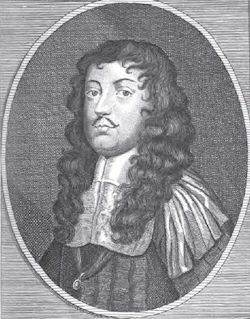 Christopher Myngs (sometimes spelt Mings) was a naval officer and privateer, who was popular among the men for leading from the front. He cannot really be classed as a pirate in the strict sense of the word, but his close association with buccaneers has earned him a reputation as being more than just a naval commander. It isn’t certain exactly when he was born, but it is thought to have been some time in the early 1620s. He is known to have originated from Norfolk in East Anglia and that he was related to Admiral Sir Cloudesley Shovell. Samuel Pepys, the writer and politician, claimed Myngs’ father was a shoe maker and mother the daughter of a hoyman, a hoy being either a freight barge or a coastal fishing and trading vessel, usually sloop-rigged, used during the 17th and 18th centuries. He went to sea at an early age on merchant vessels, joining the Parliamentary navy during the English Civil War.…
Robert Culliford
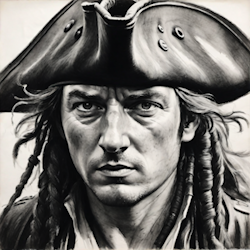 Robert Culliford was born in about 1666 in East Looe, Cornwall. He was sometimes referred to as Collover. In his early career he was an associate of the later infamous William Kidd, serving with him aboard the French privateer Sainte Rose in 1689. When the Nine Years’ War broke out in 1688, they both, together with the six only other British seamen aboard, mutinied and seized a the ship as a prize from its captain, Jean Fantin. They renamed it Blessed William. In February 1690, Culliford led a mutiny against Kidd, abandoning him and electing William Mason as captain. They then roamed the Caribbean taking prizes, eventually heading to New York to sell their ill-gotten gains. Mason was granted a commission by Jacob Leisler, acting governor of New York and leader of Leisler’s Rebellion, and Culliford accompanied him when they raided two French Canadian towns and captured the French frigate L’Esperance.…
Laurens de Graaf
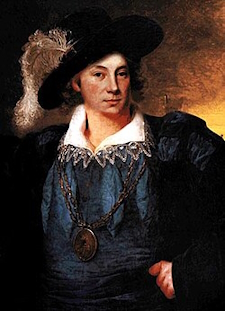 De Graaf’s full name was Laurens Cornelis Boudewijn de Graaf. He was known as ‘El Griffe’ by the Spanish, Laurent de Graff by the French, and Gesel van de West by the Dutch, the latter meaning “Scourge of the West”. He was born in about 1653 and is described as being dashing in appearance; a tall, handsome fellow with blond hair and a moustache. He apparently deplored unnecessary violence and was known to reward loyalty generously, but also to enforce discipline ruthlessly at times. He probably grew up in Rotterdam, where he acquired the necessary nautical skills for his future career. It is thought he was captured by the Spanish, possibly after involvement in a raid on Campeche in 1672, and sent to work on a plantation as a slave to the Canary Islands. He either escaped or was freed sometime around 1675. He married Petronilla de Guzmán some time before 1674 before leaving the Canary Islands for the Caribbean.…
Bartholomew Sharp
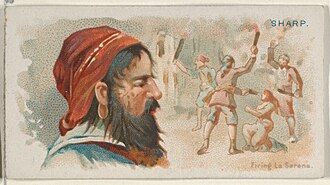 Bartholomew Sharp took on the role of buccaneer, privateer, and pirate at different times in his sea-faring career. Little is known about his early life, except that he was born in 1650 in the parish of Stepney in London. He first went to sea at a young age serving as a privateer during the second Anglo-Dutch war of 1665-67. He is thought to have served under Henry Morgan in the Caribbean, possibly during the infamous Panama raid in 1671. When peace was signed between England and Spain in the Treaty of Madrid in 1670, he became a privateer against the Dutch during the Third Anglo-Dutch war of 1672-74, obtaining the command of his own vessel in the Caribbean while fighting against the Dutch in the Leeward Islands. Once peace had been signed with the Dutch he and his men illegally turned their attention to the Spanish colonies, attacking Segovia in 1675 and capturing of Santa Marta in 1677, as well as later seizing a Spanish merchant ship in the Bay of Honduras.…