
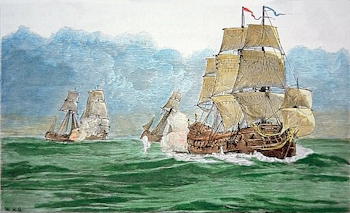
 The terms pirate and privateer are unclear to many people, but there was a clear distinction which was made between the two in the past, even if a shadowy grey area did exist for many people. In fact, during the Age of Sail, one man’s privateer was often another man’s pirate. First we must look at what a pirate is. The word itself is derived with the Greek peiratēs, meaning brigand, and like a brigand or bandit there were no restrictions on whom they attacked. They were outlaws plain and simple, possessing no legal commission, or one which covered the specific act of aggression they carried out. They often had their own flags, usually only flying the flag of a nation under false colours to trick their prey, although those pirates who considered themselves patriots might have flown the flag of their own nation too. They usually obtained their vessel by means of mutiny or capture. Pirates were often out-of-work privateers or dissatisfied seamen, who elected their captain democratically and they were free to do what they wanted with their prizes. Most pirates preferred to view themselves as privateers and patriots, especially when confronted by the law.
The role of privateers compared to pirates
Privateers played a crucial role in naval warfare, disrupting enemy supply lines and damaging their economy. But what was the legal difference to pirates? There were grey areas, but generally privateers were granted letters of marque or commissions, which gave them the authority to seize enemy ships and cargo, mostly in times of war, or to even hunt pirates. A letter of marque was given to merchant ships carrying a cargo, allowing them to capture enemy ships during their merchant voyage, but not making it the main reason for their journey. A letter of marque and reprisal could be granted if a ship owner was wronged by a foreign power. The earliest mention of such a letter is in a patent roll of Edward I from 1293. Letters of marque were officially abolished after the Congress of Paris in 1856. Commissions were handed out to private warships carrying no cargo to supplement weak navies, being more numerous in times of war with the aim of commerce raiding, known as a guerre de course in French. A commission was often for only a set duration and from a specific government to attack ships of nations that the country was at war with. Commissions could be awarded for other purposes such as trade or pirate-hunting. Captain Charles Swan was commissioned to trade with the Spanish and Indians. Some say its legalized piracy, which in some cases, like that of Francis Drake, it was, at least according to the Spanish whom England was at peace with at the time. In England Drake was regarded as a national hero. Later the terms pirate and privateer were used interchangeably despite the legal difference.
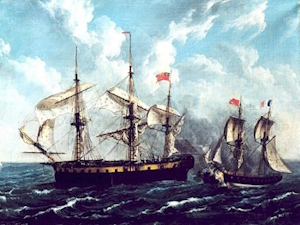 There were similarities in the tactics and types of vessels pirates and privateers used, and both preferred to captured a prize without a fight. Differences in the crews on both types of vessels were virtually indistinguishable. Pirates were uncontrollable for any governor, but privateers, on the other hand, provided an effective paramilitary force, which was crucial in early colonial times when naval power was weak, especially in the defence of Jamaica. In contrast to pirates, who answered to no-one, privateers were freelance government contractors, who had to work within a set framework and obey the law. A privateers who offered their services to the highest bidder could be considered mercenaries, which might make them traitors and pirates should their country of origin be at war with the one the privateers were serving.
Privateers had an advantage over pirates of having access to ports and easy recruitment, whereas pirates had to usually had to rely on disaffected sailors joining them from captured ships and careening their vessels in secluded bays. The pirate haven of Nassau in the Bahamas was one exception until its downfall in 1718. Pirates obtained their ships by capturing or through mutiny, whereas privateer ships were financed by a group of investors, such as in the case of Captain Kidd. The captain of a privateer ship normally didn’t own it, only being responsible for the ship during a set expedition. The discipline was a lot stricter than on a pirate ship with the privateer captain running his vessel in an undemocratic way similar to the Royal Navy. Furthermore, pirates could fly any flag they chose and often made their own; privateers were generally only allowed to fly certain flags. By order of the Admiralty in 1694, English privateers were only allowed to fly the red jack, a plain red pennant called the privateer jack; from 1697 onwards they flew plain black flags.
The taking of prizes
 On capturing a ship, pirates were free to take it as their own, burn it, or let it sail on after plundering it. On the other hand, privateers had to take their prizes back to the port where commissioned, where it was checked if the capture was legitimate before it was auctioned off. The profit was shared between the captain, crew, investors and the Crown. Any prisoners were supposed to be treated well and taken back to the commission port with the captured vessel and possibly ransomed back to their country of origin. If a privateer was captured, he was considered an enemy combatant and prisoner of war; a pirate was a simply a criminal, who was to be hanged.
Crossing the line
Grey areas arose when privateers went beyond what was allowed in their commissions, such as by attacking vessels that didn’t belong to the targeted country. One example of a privateer crossing the line occurred in 1691, when a man named Thomas Tew accepted a commission from Bermuda’s governor for a privateering venture to Africa, in order to take a French fort located on the Gambia River, but instead of attacking the French, he and his crew sailed to the Indian Ocean and plundered a Mughal ship before returning to Rhode Island with a substantial amount of treasure. Very few pirates actually referred to themselves as such, preferring to called themselves privateers. Benjamin Hornigold, who was clearly a pirate, viewed himself and his crew as patriots and privateers. Even the cruel and infamous Ned Lowe claimed to be a privateer. Pirates who called themselves privateers often refused to recognize a peace treaty or were acting out of revenge. Until 1698 someone was only deemed to be a pirate if treason was involved, but this changed with the 1698 Piracy Act.
Buccaneers
Another word much used to refer to pirates and privateers is the term buccaneer, which is specific to the Caribbean and the Pacific coast of Central America between 1655 and 1700. A West Indian sea rover, who could be either a privateer or pirate. The name is derived from the French boucan, a grill for smoking meat, and was first applied to French wild game hunters living in western Hispaniola in the early 17th century, who later turned to raiding Spanish ships and settlements. The French called them Flibustier. Buccaneers were mainly English, French or Dutch seamen, whose primary foe was Spain and their colonies. They generally preferred to attack land targets, rather than targetting ships, using their vessels to transport themselves to their target. They were often encouraged in there activities by the weak English and French colonial governments. They were regarded as privateers in war time, but, after peace treaty of 1671, they were often considered pirates if they continued to attack the Spanish without a valid commission. They had several bases, including on Tortuga and Port Royal. Some were arrested because they overstepped the line, as in the case of Henry Morgan and Bartholomew Sharp.
Corsairs
The term corsair is tied to the Mediterranean Sea, where, from the late 14th century to the early 19th century Muslim privateers targeted Christian vessels and coastlines in search of booty and slaves to sell. They operated out of north African cities such as Tripoli, Tunis, Algiers, Rabat, and Salé. It was possible for Europeans to become corsairs, but only after converting to Islam, such as in the case of John Ward, also known as Yusuf Raïs. At the time, corsairs were known to Europeans as sally rovers, Moors, or Turks. The north African sea rovers called themselves Ghazis, meaning holy warriors of Islam. The corsairs weren’t always easy to control by the North African rulers and usually had more freedom of action than European privateers. In French, the word corsair was used to mean any privateers, as is the word corsario in Spanish.
Marooners
 Marooner was a name given to pirates from the beginning of the 1700s, who used the practice of marooning as a punishment. The word is attested in 1699, and is derived from the term maroon, a word for a fugitive slave. This practice was a common punishment for crewmen or captains who had contravened the ships articles in some way. Generally, a marooned man was abandoned on a deserted island which could be no more than a sand bar at low tide. He would be given some food, a container of water, and a loaded pistol. The outcome of marooning was usually fatal, but survival was possible if the condemned was rescued or somehow managed to escape his predicament, as in the case of pirate Edward England, who built a boat after being marooned on an island with three shipmates.
Sea rover
Another widely used term is sea rover, denoting one that roves the sea. Its first known use was in 1548. A sea rover is a person who sails the seas with a focus on exploration, adventure, piracy, or privateering. The word has maritime roots, with rover originating from the Middle English word rove, meaning to wander or roam. The combined term encapsulates the essence of those who wander the seas. It is a historical term, but is still used in modern narratives to evoke a sense of romance and adventure.
For further reading, I recommend the book The Legal History of Pirates & Privateers by Thomas J. Shaw.